20071108

วังนำ้เขียว Wang Naam Khio

Moving up to the mountains of Wang Naam Khio, in Nakhon Ratchasima province, we reached the cool air and green hills of นิคมเศรษฐกิจพอเพียง (settlement for self sufficient economy) .


Like นิคมปลูกหน่อไม้ฝรั่งอินทรีย์ in Wang Sombun, นิคมเศรษฐกิจพอเพียง is a 'start up' community which began from a survey by the municipal government to identify impoverished families without land for livelyhood. The municipality contacted สปก (so-pa-kaw), an organisation which supports agricultural development, to set up a project for the people. In 2545 (2002) สปก purchased land for the project (around 4000 sqm per family) and began to train the members. The project was set up to grow gradually, with members joining in groups of 50 each year (so far 3 generations have joined). In 2548 (2005) a delegation from the new community approached CODI and was invited to join the Baan Man Kong Chonabot project.


พี่อำไพ, from the first generation to join the community and head of the commitee which approached CODI, explained to us the history of the settlement and the many works which the community is currently undertaking.

The community have set up 3 livelyhood study groups, one experimenting with growing vegetables, one focusing on raising animals, and one attempting to develop tourism. Particularly interesting is the tourism group's plan to tap into the growing trend of health tourism: 'Come to Wang Naam Khio, ride bicycles in the cool mountain air and eat fresh vegetables, its good for you!'.

The vegetable group has been trialing various crops as well as systems of irrigation and composting.


พี่อัคคี (centre page), from the second generation and head of the tourism study group runs a group of guest houses for those looking for healthier holidays.
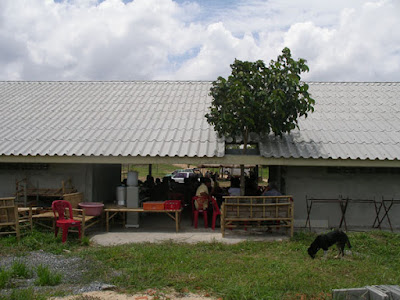

The tourism group also runs a kind of open air conference centre. CODI held a conference here for the members of Baan Man Kong Chonabot to exchange ideas and experiences.

The community have also started various other support projects, including a community shop, a micro finance group and a small workshop producing bricks for use in building houses. The brick making technology was developed by Kasetsart University.

The brick making workshop

Some problems have occured with the 'generation' system of adding members in groups each year, members from different generations have tended to stick together and not trust one another. There have been complaints from later generations of nepotism and a lack of transparency from the initial generation.

There is conflict within the community between different generations of settlers.

The community are now looking to move on from livelyhood projects and begin building houses and moving in permanently.


Some families have already established themselves permanently on the land.

20071029

วังสมบูรณณ์ Wang Sombun

In Thailand’s Northeastern 'Isan' region, close to the Cambodian border, the municipality of Wang Sombun, in the province of Sa Kaeo, has gathered together some of the poorest families of the district to join in a start-up agricultural scheme, growing organic asparagus.

Lung Gongkaa shows us around the asparagus fields


The project was the idea of the local อบต (office of the municipal government) who conducted surveys to identify those in the district most in need of assistance. The land was given by CODI as part of Baan Mankong Chonabot. The water, roads and electricity was provided by the อบต who also connected the new community with SWIFT. Co, a Thai agricultural company specializing in growing organic fruit and vegetables.

Sprinklers were provided by the อบต


Asparagus, mai farang in Thai, translates as 'caucasian bamboo'.


SWIFT. Co provided the people with seeds and training on organic methods of farming. The people have signed a 5 year contract with SWIFT guaranteeing SWIFT will buy all their produce at a fixed (and by the people’s accounts quite good) price. In exchange the people have to live with plenty of rules imposed by the company, for example, no smoking and no living on site. These rules are intended to maintain the strict organic status of the produce.

SWIFT Co. shows its contribution to the project


The CASE team speaking with Lung Gongkaa


Lung Gongkaa's simple, but sophisticated resthouse


Speaking with the อบต


Many are happy with the money they are now getting, even in the dry season (which is severe in the Isan Region) they can usually make around 500 Baht a day (around 20AU$) which is a lot more than they can get outside.

One of the farmers tells us of her new, more profitable, livelihood


The intention was to give a chance to the poorest . But for most it is not a fresh start. They carry debts from former working arrangments. Debt cycles are a common problem of the rural poor In Thailand (as in other semi feudal rural contexts). The farmer rents land on which to work, he borrows money from their landlords or potential buyers (the only locals with money to lend) in order to purchase new seed, fertilizer and pesticide, which are all necessary to produce enough to make ends meet and service the debts. The landlords and buyers often exploit this relationship with high interests or reduced payment for produce.

Even the most makeshift constructions are equipped with a Thai flag and (in this case home-made) spirit house


Some of the people do not fully trust the new system and continue to work outside as day labourers, disrupting their chances of making a fresh start and forming strong links with their fellow participants. There is a feeling amongst many in Wang Sombun that this artificial grouping of people is not yet a ‘community’, they have, after all, only been living together for the past 3 years. There are practices in place however, such as the common germination of seedlings, which are intended to build stronger relationships amongst the people.

A man packs asparagus.


The people make the most of any opportunity to socialise


In two years time the contract with SWIFT Co. runs out. There is some discussion about what else they could do with their land but most likely they will renew the contract for another 3 years.

A couple of kids go off fishing at the nearby dam


20071019

อัมพวา Amphawa


An old market town on the Mae Klong river, Amphawa has long been famous for the fireflies which live amongst the mangroves in the esturine waters where the Mae Klong meets the sea.


The hing-hoi (fireflies) are one of Amphawa's big drawcards

The CASE team began their investigation by wandering along the riverside, Pi Sut was filming, Ae was sketching, the rest of us were taking photos, asking questions and chatting with shopkeepers, homestay owners, residents, and anyone who had the time to tell a little of their own story of Amphawa.


Having a laugh with the community


and listening to their stories.


Amphawa has recently been targeted for rejuvenation through a number of tourism initiatives. A floating market has been set up. The old Chinese shop-houses have been renovated for use as shops, cafes and accommodation assisted by a partnership of Amphawa Municipality, the Office of Natural and Environmental Policy and Planning, the Faculty of Architecture at Chulalungkorn University and the Danish International Development Agency (DANIDA). In just a few years, the numbers of visitors to Amphawa has gone up dramatically, especially on the weekend, attracting hoards from nearby Bangkok. People go there for the fire flies, but is their habitat being threatened by the tourism which they attract?


The talaat naam (floating market) is a popular new addition to Amphawa


Renovated shophouses


Esturine saplings, they will grow to form part of the fireflies' habitat.


We also met with some of the community representatives who are coordinating with CODI on the Baan Man Kong assistance for Amphawa. They described some of the conflicts within the community. While the market is thriving, the economic benefits of the new visitors are not spreading to the surrounding areas. They are feeling only the negative effects: the rubbish, the noise of firefly tour boats at night. They have tried setting curfews for the boats, but they are hard to enforce. They have tried employing people to collect the rubbish but there are squabbles over who will pay their wages.


Meeting with community leaders.


While parts of Amphawa are booming...


others are left behind.


Tour boats have been a noise problem for residents at night.


There have been some successes though. Pi Daeng described an inovative strategy, sponsering a public, open-air karaoke initiative to bring people over to formerly overlooked areas of the market.


Pi Daeng explains...


...public karaoke.