In Thailand’s Northeastern 'Isan' region, close to the Cambodian border, the municipality of Wang Sombun, in the province of Sa Kaeo, has gathered together some of the poorest families of the district to join in a start-up agricultural scheme, growing organic asparagus.
Lung Gongkaa shows us around the asparagus fields
The project was the idea of the local อบต (office of the municipal government) who conducted surveys to identify those in the district most in need of assistance. The land was given by CODI as part of Baan Mankong Chonabot. The water, roads and electricity was provided by the อบต who also connected the new community with SWIFT. Co, a Thai agricultural company specializing in growing organic fruit and vegetables.
 Sprinklers were provided by the อบต
 Asparagus, mai farang in Thai, translates as 'caucasian bamboo'.
SWIFT. Co provided the people with seeds and training on organic methods of farming. The people have signed a 5 year contract with SWIFT guaranteeing SWIFT will buy all their produce at a fixed (and by the people’s accounts quite good) price. In exchange the people have to live with plenty of rules imposed by the company, for example, no smoking and no living on site. These rules are intended to maintain the strict organic status of the produce.
 SWIFT Co. shows its contribution to the project

The CASE team speaking with Lung Gongkaa

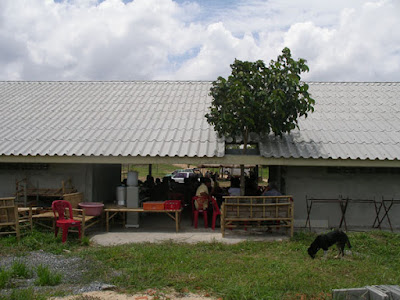
Lung Gongkaa's simple, but sophisticated resthouse
 Speaking with the อบต
Many are happy with the money they are now getting, even in the dry season (which is severe in the Isan Region) they can usually make around 500 Baht a day (around 20AU$) which is a lot more than they can get outside.
 One of the farmers tells us of her new, more profitable, livelihood
The intention was to give a chance to the poorest . But for most it is not a fresh start. They carry debts from former working arrangments. Debt cycles are a common problem of the rural poor In Thailand (as in other semi feudal rural contexts). The farmer rents land on which to work, he borrows money from their landlords or potential buyers (the only locals with money to lend) in order to purchase new seed, fertilizer and pesticide, which are all necessary to produce enough to make ends meet and service the debts. The landlords and buyers often exploit this relationship with high interests or reduced payment for produce.
 Even the most makeshift constructions are equipped with a Thai flag and (in this case home-made) spirit house
Some of the people do not fully trust the new system and continue to work outside as day labourers, disrupting their chances of making a fresh start and forming strong links with their fellow participants. There is a feeling amongst many in Wang Sombun that this artificial grouping of people is not yet a ‘community’, they have, after all, only been living together for the past 3 years. There are practices in place however, such as the common germination of seedlings, which are intended to build stronger relationships amongst the people.
 A man packs asparagus.

The people make the most of any opportunity to socialise
In two years time the contract with SWIFT Co. runs out. There is some discussion about what else they could do with their land but most likely they will renew the contract for another 3 years.
 A couple of kids go off fishing at the nearby dam


 ผุใหญ่สุภาพเลพล, the village head, explains the situation to the CASE team
 พ่อหอมดี (Papa Good Smell), the person who originally contacted CODI, shows us his land. He is able to grow enough rice to feed his family all year round and has space left over to grow vegetables and raise fish and cattle.